![[PukiWiki]](image/pukiwiki.png "[PukiWiki]")
sndio(7)は音声を統一的に扱うための枠組み(フレームワーク)で、Alexandre Ratchovらによって2008年リリースのOpenBSD 4.5に始めて導入された。 現在はFreeBSD/NetBSD/Linuxにも移植されている。
ALSA, JACK, OSS, PulseAudioなどの音声フレームワークと同様、sndioは音声を扱うハードウェアとアプリケーションとの橋渡しをする。 具体的には、sndioは以下のような機能を持っている。
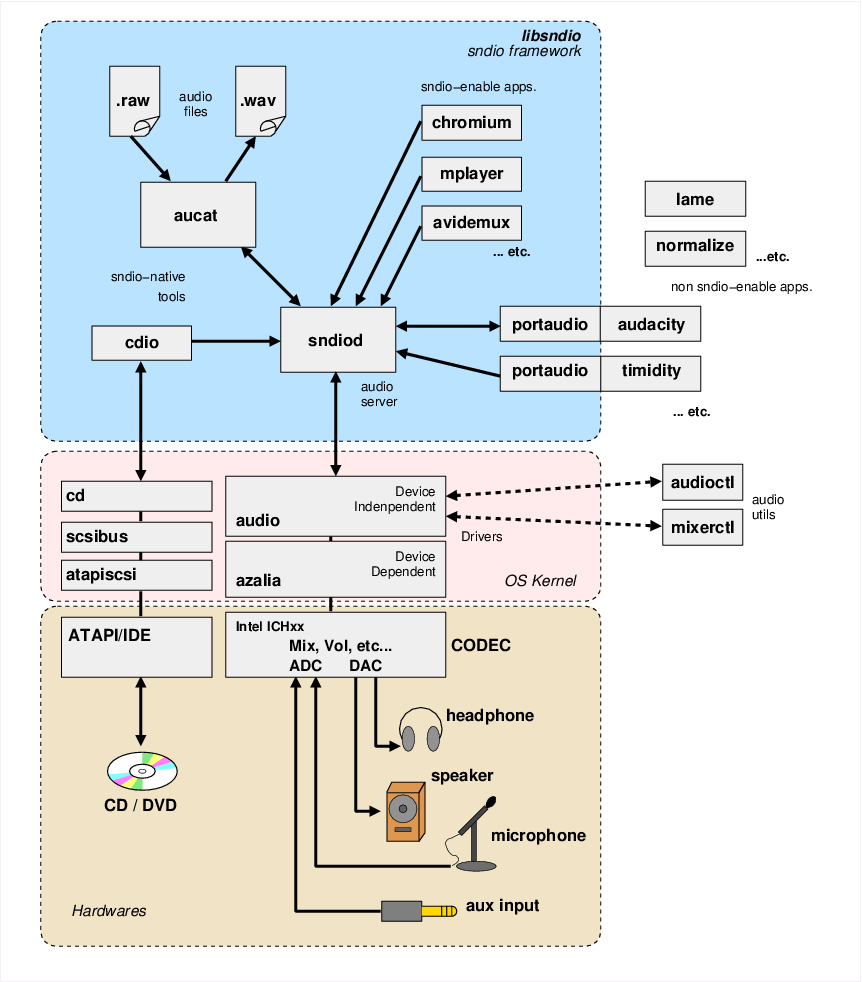
以下に、OpenBSDでsndioフレームワークが動作している様子の例を示す。
$ audioctl
name=azalia0
mode=play,record
pause=0
active=1
nblks=8
blksz=960
rate=48000
encoding=s16le
play.channels=2
play.bytes=3796930560
play.errors=883200
record.channels=2
record.bytes=3796930560
record.errors=552960
mixerctlの実行例
$ mixerctl -v | sort
inputs.dac-0:1=234,234
inputs.beep=119
inputs.beep_mute=off  [ off on ]
inputs.dac-2:3=234,234
inputs.hp_source=sel6,mix6  { sel6 mix6 }
inputs.mic2=0,0
inputs.mic3=0,0
inputs.mic3_source=sel7,mix6  { sel7 mix6 }
inputs.mic=0,0
inputs.mix4_source=sel3,mix6  { sel3 mix6 }
inputs.mix6_mic2=0,0
inputs.mix6_mic=0,0
inputs.mix6_source=mic,mic2  { mic mic2 }
inputs.sel3_source=dac-0:1  [ dac-0:1 dac-2:3 ]
inputs.sel4_source=dac-0:1  [ dac-0:1 dac-2:3 ]
inputs.sel6_source=dac-0:1  [ dac-0:1 dac-2:3 ]
inputs.sel7_source=dac-0:1  [ dac-0:1 dac-2:3 ]
inputs.spkr_source=dac-2:3,mix6  { dac-2:3 mix6 }
outputs.hp_boost=off  [ off on ]
outputs.hp_mute=off  [ off on ]
outputs.hp_sense=plugged  [ unplugged plugged ]
outputs.master.mute=off  [ off on ]
outputs.master.slaves=dac-0:1,dac-2:3,hp,spkr  { dac-0:1 dac-2:3 beep hp spkr mic3 mix6 mic3 }
outputs.master=255,255
outputs.mic2_dir=input-vr80  [ none input input-vr0 input-vr50 input-vr80 input-vr100 ]
outputs.mic3_dir=input-vr80  [ none output input input-vr0 input-vr50 input-vr80 input-vr100 ]
outputs.mic3_mute=off  [ off on ]
outputs.mic3_sense=unplugged  [ unplugged plugged ]
outputs.mic_dir=input-vr80  [ none input input-vr0 input-vr50 input-vr80 input-vr100 ]
outputs.mic_sense=plugged  [ unplugged plugged ]
outputs.mix6=0,0
outputs.mix6_mute=off  [ off on ]
outputs.spkr_boost=off  [ off on ]
outputs.spkr_eapd=on  [ off on ]
outputs.spkr_mute=on  [ off on ]
outputs.spkr_muters=hp,mic3  { hp mic3 }
record.adc-0:1=200,200
record.adc-0:1_mute=off  [ off on ]
record.adc-0:1_source=mic  [ mic mic2 ]
record.adc-2:3=200,200
record.adc-2:3_mute=off  [ off on ]
record.adc-2:3_source=mic2  [ mic mic2 ]
record.volume.mute=off  [ off on ]
record.volume.slaves=adc-2:3,adc-0:1  { adc-2:3 adc-0:1 mic mic2 }
record.volume=200,200 portaudioを使っているportsを数えてみる $ cd /usr/ports $ find * -type d -name patches | xargs grep -rils 'portaudio' | cut -d/ -f1,2 \ | sort | uniq | wc -l 12
sndio対応のパッチを当てているportsを数えてみる
$ cd /usr/ports
$ find * -type d -name patches | xargs fgrep -rls 'sndio.h' | cut -d/ -f1,2 \
| sort | uniq | wc -l
41
音声デバイスが無制限に共有されないように、sndioではセッションクッキーを使った認証を行う。
sndiodに接続時、音声アプリケーションは$HOME/.aucat_cookieに可能された128ビットのランダムなデータをクッキーとしてsndioに提示する。
クッキーとして$HOME/.aucat_cookieを使うため、通常は同一のユーザからの接続のみが同時に受け入れられるが、$HOME/.aucat_cookieを同じ内容にすれば異ったユーザ間でもsndiodの共有が可能となる。
sndiodはデフォルトではUNIXドメインソケットでの接続のみ受け付ける。INETドメインでの接続を受け付ける場合は-Lオプションで明示的に指定する必要がある。
sndio APIを使用するには、libsndioより提供される各種関数を使う。
sio_*が音声ストリーム関連、mio_*がMIDIストリーム関連の関数となる。
処理の流れ:
sio_initpar()  /* パラメータの初期化 */
   ↓
sio_open()     /* 音声デバイスや音声サーバに接続 */
   ↓
sio_setpar()   /* パラメータの設定 */       ←←←←
sio_getpar()   /* 設定結果の確認 */                ↑
   ↓                                              ↑
sio_start()    /* 処理の起動 */             ←←←-↑
   ↓                                              ↑
sio_read(), sio_write()  /* 入出力 */              ↑
   ↓                                              ↑
   ↓→→パラメータを変更する場合→→ sio_stop() →↑
   ↓    処理を一時的に中断する場合など
   ↓
sio_close()     /* 接続を閉じる */
MIDI接続の場合も、これに準ずる。
sio_open()では、一番目の引数で、以下の記法によって接続先を指定する:
type[@hostname][,unit]/devnum[.option]
この記法はsndiodやaucatなどで音源のデバイスやサーバに接続する場合の接続先指定としても使用される。
例:
rsnd/0 ... /dev/audio0 に直接アクセス (sndiodを介さない)
snd/0.rear ... デフォルトで起動しているsndiodのリアスピーカ出力
参考:
# rcctl set sndiod flags '-s default -m play,mon -s mon' # rcctl restart sndiodこの設定を行っておくとffmpeg実行時、-i snd/0.mon を指定することで、スクリーンキャプチャ時にアプリケーションの再生音も同時に収録できる。
$ ffmpeg -f x11grab -s 800x600 -i :0.0+100,100 -f sndio -i snd/0.mon screencapt.mpg
remote_host # rcctl set sndiod flags '-L -'
remote_host # rcctl restart sndiod
ローカルでのコマンド実行
local_host $ aucat -f snd@remote_host/0 -o - | lame -r -s 48 - recinput.mp3
/* sin_osc ... generates sine waves
 *             and outputs to sndio default device
 *
 *   Ch. 1:  1kHz, -6dBFS
 *   Ch. 2: 400Hz, -6dBFS
 *
 *   Duration: 60 secs
 */

#include <stdint.h>
#include <stdlib.h>
#include <stdio.h>
#include <math.h>

#include <sndio.h>

/* frequency parameters in Hz */
#define SAMPLE_FREQ 48000.0
#define OUTPUT_FREQ1 1000.0
#define OUTPUT_FREQ2  400.0

/* buffer size of waveform */
#define SAMPLES 480

/* SAMPLES per CYCLE */
#define SPC1 (SAMPLE_FREQ/OUTPUT_FREQ1)
#define SPC2 (SAMPLE_FREQ/OUTPUT_FREQ2)

/* output level of sine wave with:
 *   sampling point 't',
 *   samples per cycle 'spc'
 */
#define SINVAL(t, spc)    ((int16_t)(INT16_MAX*sin(2.0*M_PI*t/spc)/2))

void fail_exit(const char *msg) {
  fprintf(stderr, "%s failed\n", msg);
  exit(1);
}

int main() {
  /* waveform buffer */
  int16_t wf[2*SAMPLES], /* signed 16bit per sample */
          *p_wf;

  /* fill buffer */
  p_wf = wf;
  for (int i = 0; i<SAMPLES; i++) {
    *p_wf++ = SINVAL(i, SPC1);  /*  1kHz to Ch1 */
    *p_wf++ = SINVAL(i, SPC2);  /* 400Hz to Ch2 */
  }


  /* initialization of sndio */

  struct sio_par par;
  struct sio_hdl *hdl;
  ssize_t n;

  sio_initpar(&par);
  par.sig = 1;
  par.bits = 16;
  par.pchan = 2;
  par.rate = 48000;

  hdl = sio_open("snd/0", SIO_PLAY, 0); /* "snd/0" may be SIO_DEVANY */
  if (hdl == NULL)                      /* or "default".             */
    fail_exit("sio_open()");

  if (!sio_setpar(hdl, &par))
    fail_exit("sio_setpar()");

  if (!sio_getpar(hdl, &par))
    fail_exit("sio_getpar()");

  if (!sio_start(hdl))
    fail_exit("sio_start()");

  /* output for 60 secs */
  for (int i=0; i<6000; i++) {
    n = sio_write(hdl, wf, sizeof(wf));
    if (n == 0)
      fail_exit("sio_write()");
  }

  sio_close(hdl);

  return 0;
}
$ LDFLAGS='-lm -lsndio' make sin_osc
cc -O2 -pipe   -lm -lsndio  -o sin_osc sin_osc.c
$ ./sin_osc


